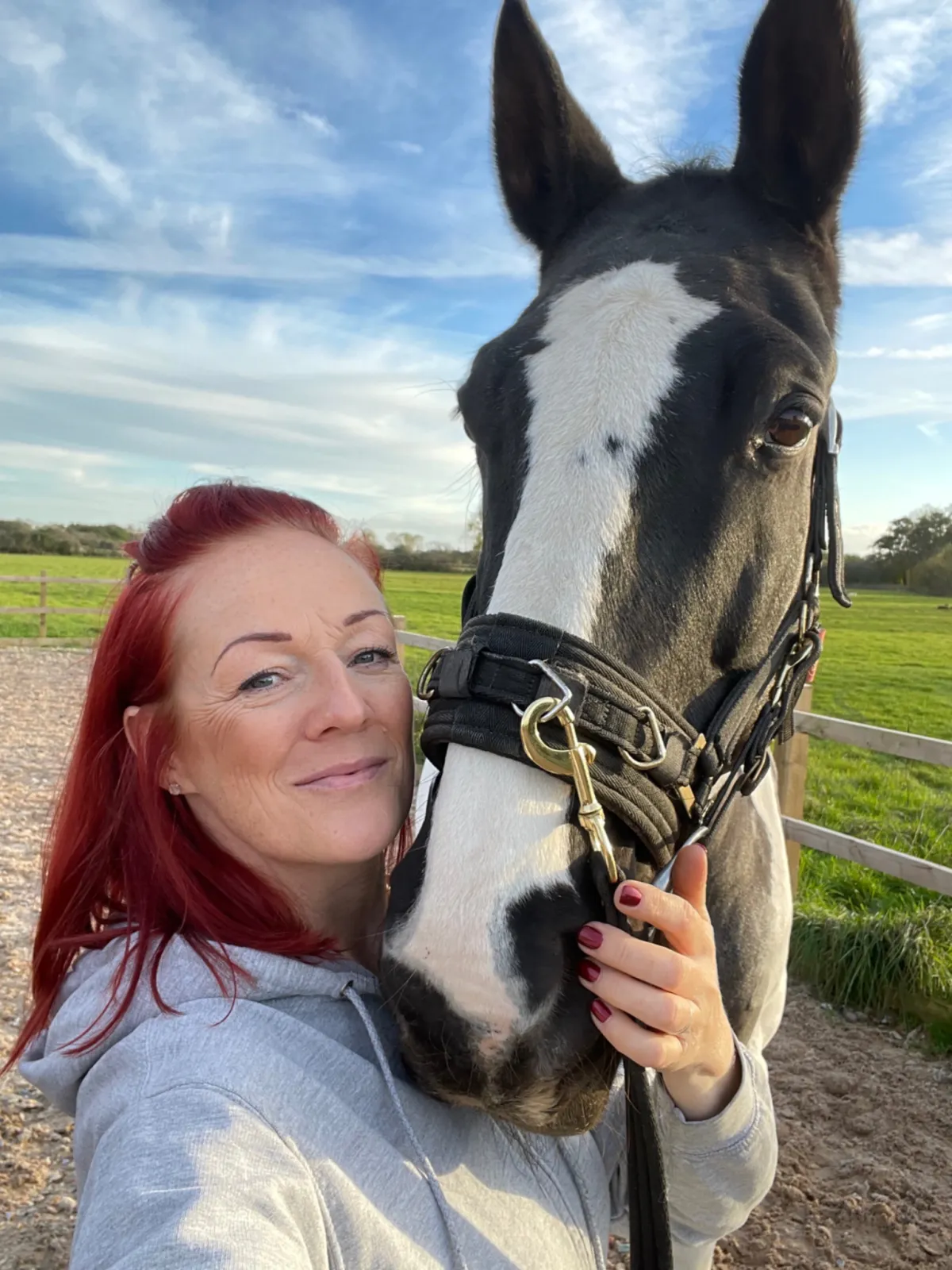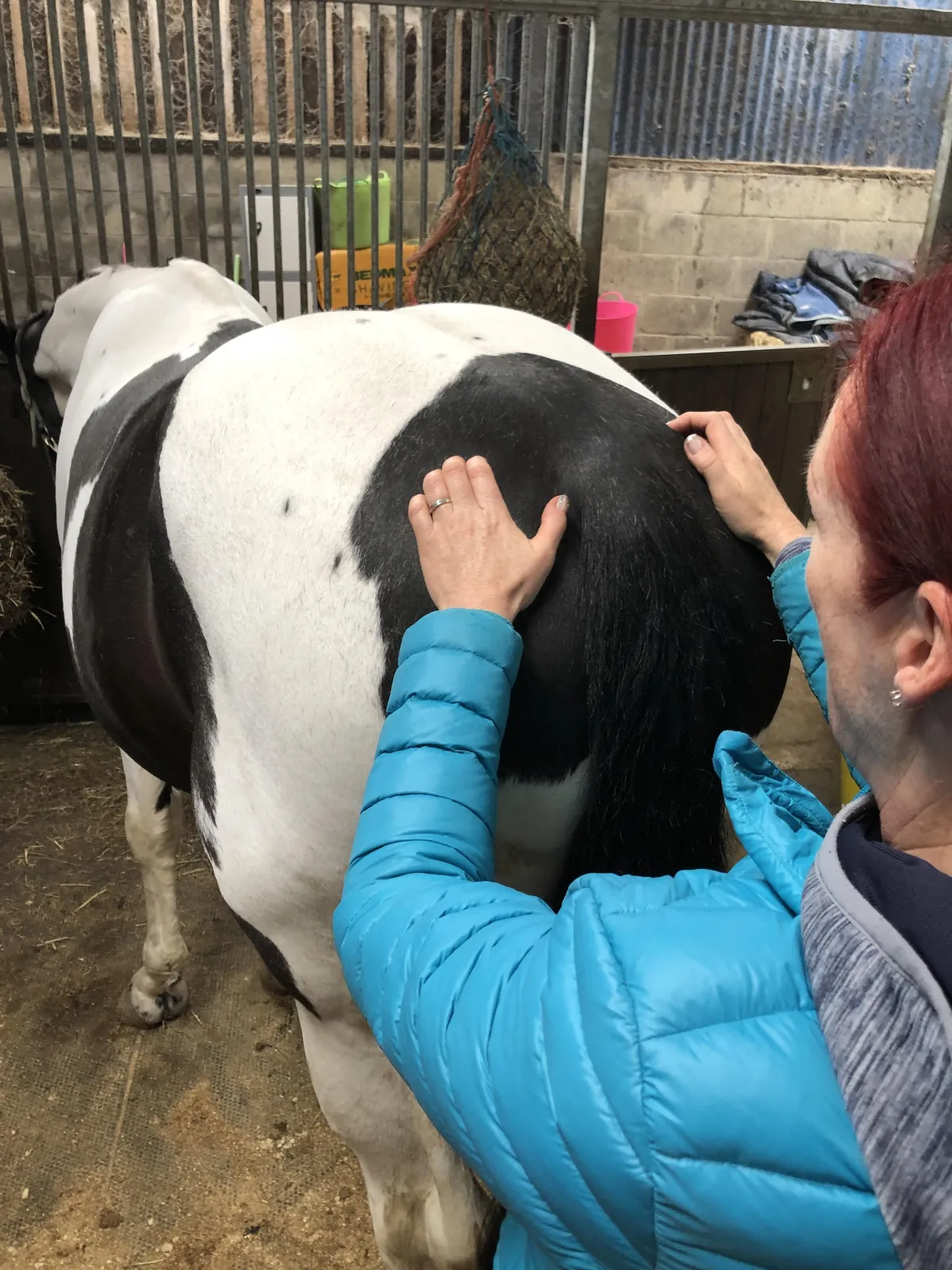
How Core Exercises Changed Everything For My Kissing Spine Horse
If you read last week's blog, you'll know that Azuro's kissing spine diagnosis came with a lot of emotion.
The relief of finally having an answer. The devastation. The overwhelming question of what on earth to do next.
This week I want to talk about what came after all of that.
Because the diagnosis is just the beginning.
What you do next — and how consistently you do it — is what actually determines how your horse feels, moves, and performs for the rest of their life. ✨
Two weeks after Azuro's surgery, his staples came out.
And I started the core exercises immediately.
Not cautiously. Not tentatively.
With absolute conviction — because everything I knew clinically told me this was the single most important thing I could do for him at that moment.
Here's what happened over the weeks and months that followed.
His topline began to change.
The muscle that had dropped away — that slight dip in the middle of his back that so many KS horses develop — started to change. Slowly at first. Then more noticeably.
His way of going shifted.
He began to carry himself differently. More lifted. More connected. Less braced.
And the crookedness — which had been so stubborn even after the surgery itself — started to respond once the core work was properly underway and we added in-hand work alongside it.
I watched my horse come back.
Not just to where he was before.
To somewhere better. 🦄
And here's what strikes me most, eight years on.
The work has set new defaults for his body.
He stands square at rest — eating from his feed bucket, just hanging out in the stable. Most horses don't stand square. Azuro does, consistently, because that's become his natural resting posture.
He's genuinely flexible through his back in a way he never was before — which means when he comes back into work after time off, he's quick to tone up, easy to mobilise, and responds fast.
The crookedness and compensation patterns that defined him for so long have been replaced by something better.
A body that knows how to carry itself. 🦄
I saw a client this week whose horse had kissing spine surgery at around the same time as Azuro — eight or nine years ago, similar age.
I still see them every three months.
And every visit is straightforward.
Not because KS horses are easy. But because this owner followed the strategies consistently, year after year. And the result is a horse with exactly the same kind of defaults as Azuro — flexible through the back and core, easy to bring back into work and tone up, relatively symmetrical for a horse of his age.
That horse has become what he is because of the work put in.
And that's what's possible when you get the foundation right and keep it going. 💚
So let me explain exactly why these exercises are so powerful for a KS horse specifically.
Because it's not just about "building strength." It's more targeted than that.
The exercises create space.
The dorsal spinous processes — the bony projections along the spine that give KS its name — are naturally closest together in the middle of the back. Right where we sit. Right where the most pressure is.
Specific core exercises actively work to create more space between those processes. They decompress the area that's been under pressure — gently, gradually, without loading the spine.
The exercises build the right muscles.
The deep postural muscles alongside the spine — the multifidus — are the ones that provide stability, support and protection to the vertebrae. In a KS horse, these muscles are often weakened or inhibited because the horse has been compensating and bracing for so long.
Core exercises specifically target and rebuild these muscles. Not the superficial muscles on top — the deep ones underneath that actually hold and protect the spine. 💪
The exercises change how the horse carries themselves.
Over time, with consistent work, the horse learns a new postural pattern. They stop bracing. They stop protecting. They start to use their body in a way that supports rather than loads the back.
And that change — once it happens — is genuinely remarkable to witness.
Here's what I want every horse owner to understand.
Core exercises aren't just for horses who have had KS surgery.
They're not just for horses in active rehabilitation.
Every horse benefits from this work.
Because of the anatomy of the equine spine — with those bony projections sitting closest together in the middle of the back, right where a rider sits — every horse under saddle is placing load on that vulnerable area.
Core exercises help prevent the damage from accumulating in the first place.
I've seen this backed up in clinical research, confirmed by specialist vets, and witnessed firsthand in hundreds of horses.
Whether your horse has a KS diagnosis, is post-surgery, is in long-term management, or you simply want to protect their back going forward — this work is foundational. 🐎
Now let me be honest about what core exercises are — and what they aren't.
They're not complicated.
They're stable-based, gentle, and most horses genuinely enjoy them once they become part of the routine.
They don't require an arena, a lunge line or any specialist equipment.
They take between 5 and 15 minutes depending on where you are in the programme.
What they do require is consistency and correct technique.
Because done incorrectly — or inconsistently — the results are limited. Done correctly and consistently, the results are transformative.
There are two categories of exercises that form the foundation of a KS rehabilitation and prevention programme:
Mobilisation exercises — gently moving the spine through its range of motion, releasing tension and encouraging flexibility in a controlled way.
Core activation exercises — specifically targeting the deep postural muscles, by encouraging the horse to reach in specific directions, creating length, decompression and lateral flexibility through the spine.
These aren't random exercises. They work together as a system — mobilising first, then activating, and strengthening over time. ✨
This is the work that transformed Azuro.
And it's the work I've built my entire teaching method around.
If you have a KS horse and want the complete system — the full method, step by step, with everything explained — my signature course How to Build a Stronger, Straighter Horse is exactly what you need.
It covers the complete foundation: why your horse moves the way they do, how to address crookedness and postural issues at the root, and the progressive exercise programme that builds genuine strength and symmetry over time.
Everything in one place. Self-paced. Lifetime access.
£127 / $170
👉 How to Build A Stronger Straighter Horse
And if you're just starting out and want an accessible expert guide specifically for KS — my Kissing Spine Rehabilitation & Prevention Strategies Ebook is the perfect starting point.
£14.99 / $20
For the foundation exercises that underpin everything else — my Core Exercises Course gives you the step-by-step stable-based routine I've used with Azuro for eight years.
Just £9 / $12 — lifetime access.
And if you want personal, tailored support for your KS horse's rehabilitation —
👉 Get in touch via the contact page: Contact me
💚