What Your Horse's Posture Is Telling You Every Single Day
Before you tack up.
Before you pick up a headcollar.
Before you ask anything of your horse at all.
There's a conversation already happening.
And most owners walk straight past it. 🦄
Every time you arrive at your horse's stable, their body is telling you something.
Not dramatically. Not obviously.
Just quietly. Consistently. Every single day.
And once you learn to read it — really read it — everything about how you approach your sessions changes.
This is one of the first things I do when I visit any horse professionally.
Before I watch them move. Before I put my hands on them. Before I do anything clinical at all.
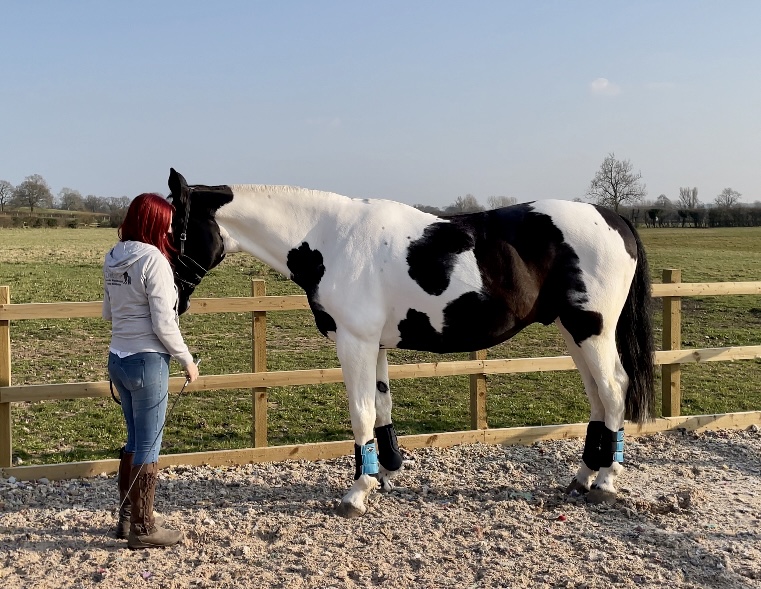
I stand back and I look.
How are they holding their head? Is there tension through the neck — a slight brace, a tightness, a way of carrying themselves that's just a little too high or too fixed? What does the topline look like — is there muscle there, or has it dropped away? Is it even on both sides? How are they standing? Is their weight evenly distributed or are they already compensating, shifting, protecting something?
None of this takes long.
A minute or two. Maybe less.
But those few minutes tell me more than almost anything else. ✨
Tension in a horse's body isn't always obvious.
It doesn't always look like a horse that's naughty or resistant or difficult.
Sometimes it looks like a neck that's just a little tight. A topline that's a little flatter on one side. A way of standing that's slightly guarded.
These are the early signs. The quiet ones.
And they matter — because tension left unaddressed doesn't stay quiet for long. 💚
It builds. It spreads. It starts showing up as resistance under saddle, stiffness on one rein, a feeling that something isn't quite right but you can't put your finger on what.
Here's something that might surprise you though.
Your horse's posture isn't just about their body.
It's also about yours.
Horses are extraordinarily sensitive to the emotional and physical state of the people around them. Their nervous system is wired to pick up on tension — it's a survival mechanism that's been there for thousands of years.
Which means when you arrive at the yard stressed, rushed, carrying the weight of your day…
Your horse feels it. 🐎
Think about it from their perspective.
They're a prey animal whose survival has always depended on reading the body language of those around them. They notice everything — your breathing, your posture, the tension in your hands, whether your mind is actually at the yard or still stuck in the traffic on the way there.
If you're tense, they're braced. If you're distracted, they're unsettled. If you're rushing, they're already two steps ahead of you wondering what the threat is.
They're not being difficult.
They're responding to you — exactly as nature designed them to. ✨
So the two minute stable check isn't just about observing your horse.
It's about giving yourself a moment too.
To arrive. To breathe. To leave what's happened before the yard gate behind you.
Because a horse who sees a calm, grounded owner walk through that door is already in a different state than one who sees someone rushing.
And that difference shows up in their posture, their tension levels, and how the whole session unfolds. ✨
What you do next matters too.
Once you've observed — once you know what you're working with that day — you have a choice.
You can tack up and hope for the best.
Or you can spend a few minutes doing something about it.
Core activation exercises are one of the most effective ways to begin releasing physical tension and switching on the right muscles before you ask anything of your horse. A few minutes in the stable, before you even get to the arena, and you'll feel the difference the moment you start. 💪
And if you notice that the tension in your horse is mirroring the tension in you — that's worth paying attention to too.
Learning to regulate your own nervous system before you work with your horse isn't a luxury.
It's one of the most practical things you can do for them.
Two things that help enormously with both:
My Core Exercises Course — for the physical side. Stable-based activation that begins to release tension and build the right foundation before every session.
Just £9 / $12 — lifetime access.
👉 CLICK HERE for Core Exercises Course
And my Breath & Grounding Course — for the connection side. Simple, practical breathwork and grounding techniques that shift your state before you even touch your horse.
Just £49 / $68 — lifetime access.
👉 CLICK HERE for Breath & Grounding Exercises Course
💚