The Grazing Pattern Behind Crookedness
Last week I mentioned that most horses find one side a little easier than the other, the same way we’re left or right handed. This week I want to show you where that pattern can start, because it’s not where most people look. 🦄
The other 23 hours
You probably ride your horse for around 45 minutes, on a good day. That leaves a lot of hours when they’re doing something else, and for most of them, they’re eating.
Go and watch your horse graze
Next time you’re at the field, take a few minutes and just watch them. Head down, one front leg forward, one back. In my experience, it’s nearly always the same leg forward, and they repeat it for hours, every single day.
Why it matters
One study followed 24 foals through their first year. About half of them developed a habit of putting the same front leg forward when grazing, and those foals went on to develop uneven front feet. That’s how powerful a repeated, everyday posture is.
Think about how you’d feel if you stood with your weight on the same leg, or carried your bag on the same shoulder, for hours a day, for years. Sooner or later your hip, your back and your shoulders would let you know about it.
Your horse’s body is no different. If one front leg is loaded differently from the other for hours on end, it doesn’t just stay in the leg. It shows up through the shoulder, the neck, the back and the ribcage, and it might already explain how your horse feels under saddle: the rein they lean on, the side they fall in on, the bend that’s easy one way and stiff the other. It’s often the same side they find harder in their work.
The grazing pattern isn’t the only cause, but it’s one of the everyday habits that keeps feeding it.
And in winter, it moves indoors
With less grass, your horse is eating more hay, often from the same spot, in the same corner, standing the same way, every day. A few simple swaps help:
Move the hay around. Change the corner, or split their hay into two or three haynets in different parts of the stable.
Hang them at different heights. If you’re splitting their hay into, say, three nets, hang each one at a slightly different height. Through the day your horse then reaches forward, up and down, moving their neck through lots of different ranges instead of holding one position for hours. I think of it as passive physio! (Do make sure every net is hung high enough that it can’t catch a leg once it’s empty.)
Feed some from the floor where you can, so they’re stretching down the way they would when grazing.
Notice how they stand at the hay, and whether it’s always the same way.
There’s a fascinating reason this variety matters for the neck in particular. Australian researcher Sharon May-Davis studied the nuchal ligament, the big elastic ligament that helps support your horse’s head and neck. Anatomy textbooks describe it attaching all the way down to the last two neck vertebrae, C6 and C7. In almost every modern horse she examined however, it didn’t reach either of them. Donkeys, zebras and Przewalski’s horses still have that attachment, which suggests modern horses lost it after domestication.
So the base of your horse’s neck relies more on its muscles for support. Varied, natural movement through the day helps keep those muscles working.
They’re small changes, but over a whole winter they add up.
Why crookedness keeps coming back
This is the bit I really want you to take away. If a pattern is being practised for hours every day, two or three good sessions a week can’t simply undo it. You can do a lovely in-hand session on Tuesday, but by Thursday the body has gone back to what it does all day. That’s why crookedness so often improves, then slides back.
It isn’t that the exercises don’t work. It’s that changing a pattern that runs all day needs the right exercises, on both sides, done consistently, over weeks and months.
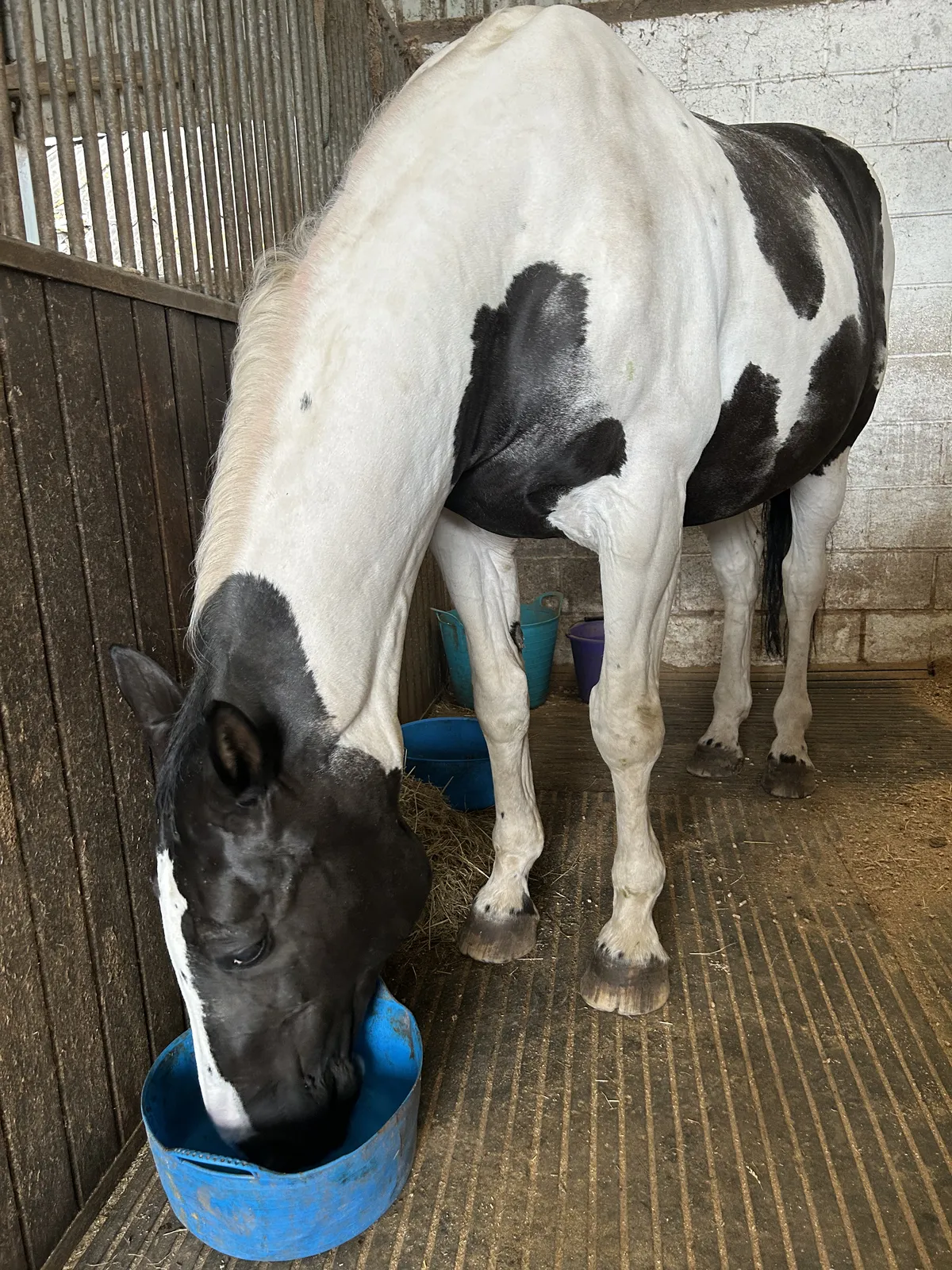
And it can be changed. I’ve worked on Azuro’s posture, core strength and symmetry for years, and he now stands square as his default. When he eats from his bucket on the floor, which is exactly where most horses fall straight back into their grazing pattern, he still stands square. And he stands square at rest too. That’s what consistent work looks like, and it’s why I’m so sure it’s possible.
I’ll be going much deeper into this on my free live training on Thursday 3rd December, How to Build a Stronger, Straighter Horse. 👉 Save your free spot here.
What to do this week
1. Find their pattern. Watch them graze or eat hay. Which leg is usually forward? Take a photo or two.
2. Check it at the halt. Stand them up. Which front leg tends to stay forward? Which hind leg do they leave out behind? Do they do this every time you halt?
3. Work the other side. In-hand, ask for standing square, equal bend both ways and straight backing up. Spend a little longer on their more difficult side.
4. Add walk poles. In walk, each leg has to take its own share of the work, which makes it far harder for the weaker side to hide.
And if you don’t have the Core exercises yet, they’re a great place to start. They switch on the deep muscles that help your horse hold a straighter posture, in 10 minutes in the stable. Core Exercises Course, £9 / $12.
Want to go deeper?
On Thursday 3rd December I’m running a free live training on Zoom: How to Build a Stronger, Straighter Horse. I’ll go further into crookedness patterns like this one, why they hold on so tightly, and what a realistic winter plan looks like to start changing them.
👉 Save your free spot: CLICK HERE
Want to start working on your horse’s pattern now?
The In-Hand Exercises Course. Standing square, equal bend, backing up straight, and building up to shoulder-in and other lateral exercises. Work both sides of your horse’s pattern from the ground. Half price at £49.50 / $68.
👉 In-Hand Exercises Course: CLICK HERE
Add the Polework Course. Simple walk pole layouts that make every leg do its share, so the weaker side can’t hide. £35 / $45.
👉 Polework Course: CLICK HERE
If you have any questions, need help deciding which course is right for you and your horse, or want to chat about 1-2-1 support, you can get in touch via the Contact page. I’d love to hear from you. 💛