Why Your Horse Bends Better One Way — And What's Really Going On In Their Body
You already know which rein is harder.
Every horse owner does.
The circle that flows. And the circle that doesn't.
The bend that comes easily. And the one that feels like pushing through concrete no matter how long you work at it.
Here's what I want you to understand about that.
It's not a training problem.
It's not something you can lunge out of them or ride out of them.
It's a whole-body pattern that's been there since birth — and it runs through everything your horse does, every single day. 🦄
Let me introduce you to two terms that might just change how you think about your horse's body forever.
Locked short. And locked long.
Every horse has a dominant side — a natural asymmetry, just like humans have a dominant hand. And that asymmetry creates two very different patterns on either side of their body.
The locked short side is compressed and shortened along its length.
The muscles along that side of the body have less range of motion. The ribcage is tighter. The horse finds it harder to lengthen through that side of their body — which means bending away from it is genuinely difficult. Not because they're being difficult. Because their body physically won't go there easily.
The locked long side is the other side of the same pattern.
It's lengthened — but not in a good way. The muscles on the lengthened side of the body are stretched out and unable to properly shorten, flex and engage. They lack the ability to contract efficiently. Which means the horse often falls out through that shoulder, and can't properly engage that side of their body. ✨
The two sides create each other.
One compresses. The other over-lengthens in response.
And the whole body organises itself around that pattern.
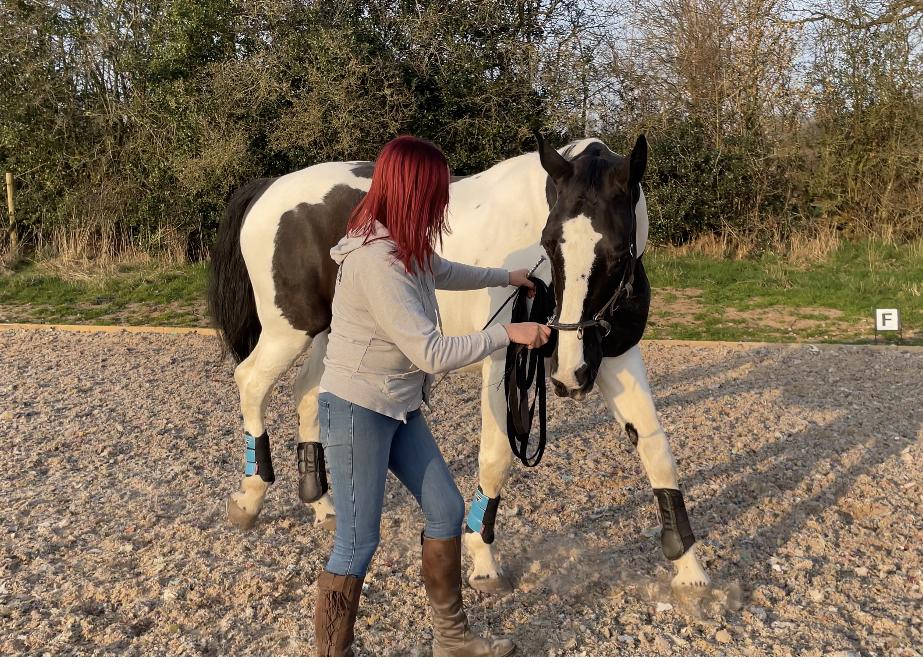
Azuro is a perfect example.
His default is shortened along his right side — his right ribcage, his right neck, his right whole body length.
Which makes left bend the harder direction. Not because he's stiff in his neck on that side — but because his right side simply won't lengthen enough to allow the left bend to happen fully.
Even on the lunge without a rider, you'd see it.
The circle flows in one direction and feels blocked in the other.
Because this isn't about what we're doing as riders or handlers.
It's about what's happening inside the horse's body. 🐎
And here's the crucial thing.
You cannot ride this pattern out of a horse.
You cannot lunge it out of them.
It's a lifelong whole-body pattern that needs to be trained — specifically, patiently, consistently — on both sides.
The locked short side needs to learn to lengthen.
The locked long side needs to learn to shorten and engage.
And the most effective way to do both?
From the ground. In hand. Without the weight and complexity of a rider in the picture. 💪
This is where in-hand work becomes genuinely transformative for this specific problem.
From the ground, you can see things you simply cannot feel or address properly from the saddle.
Where the shoulder is blocking. Where the neck won't soften. Where the ribcage won't swing.
And from the ground, you can do something about it in a way that ridden work simply can't reach.
You can nudge that stiff shoulder with just a fingertip.
You can ask for a little more bend than usual on the locked short side — gently encouraging the body to go somewhere it's been avoiding.
You can work the locked long side to engage, shorten and activate in a way that builds the muscle memory of actually using those fibres properly.
All without the complication of managing a rider at the same time.
The horse can focus entirely on finding the movement. And you can see — in real time — exactly where the blocks are and help to flex them with the most subtle, helpful adjustments. ✨
It's one of the most powerful things you can do for a horse with a strong locked short/locked long pattern.
But even before the in-hand work — there's something you can do in the stable, before you've even tacked up.
The lateral stretches in core exercises are actually the daily antidote to this pattern.
When you ask your horse to reach to the left, you're encouraging the right side — the locked short side — to lengthen, and the left side - the locked long side - to engage and shorten. And the same the other way.
Done consistently before every session, these exercises begin to address the pattern from the inside out, by equalising each side of the body.
And so the body starts to learn a new way of being — even before you've picked up a lead rope. 🦄
If you want to truly understand what's happening in your horse's body — and have a complete, structured method to address it — my signature course How to Build a Stronger, Straighter Horse starts with exactly this.
The crookedness masterclass in Module 1 goes deep on the lifelong pattern in your horses body— what's causing it, what it means for your horse's movement, and how to start working with it rather than against it.
Combined with the core exercises, in-hand work, poles and lunge work that follow — it's the complete picture.
Self-paced. Lifetime access. The whole method in one place.
£127 / $170
👉 How to Build A Stronger, Straighter Horse: Click Here
Or if you want to focus specifically on the ground work — my In-Hand Exercises Course is the step-by-step method for working both sides from the ground.
Currently half price at just £49.50 / $68 with lifetime access.
👉 In Hand Exercises Course: Click Here
And for the daily stable-based antidote — the exercises that begin addressing the pattern before every session:
Core Exercises Course — just £9 / $12 with lifetime access.
👉 Core Exercises Course: Click Here
And as always, if you have any questions, need help deciding which course is right for you and your horse, or want to chat about 1-2-1 support — please get in touch via the Contact page. I'd love to hear from you. 💛